Unit Aim Start here
This unit is about operating, moving or manoeuvring the fork lift truck. It covers observations, pivot and reference points when turning, smooth driving and stopping, negotiating inclines and declines, and actions required to reduce risks.
The unit is relevant to those who operate, move or manoeuvre fork lift trucks, or those who are responsible for fork lift trucks within logistics organisations.
Mission Challenge
You enter a tight loading bay with a mixed-height load. What are the first three checks you make before moving?
Reveal model answer
Check area hazards and pedestrian routes, confirm load condition and stability, then set fork travel position and visibility before manoeuvring.
How confident are you on this section?
Pick one to save your progress on this device.
Learning Outcomes 1 and 2 Core content

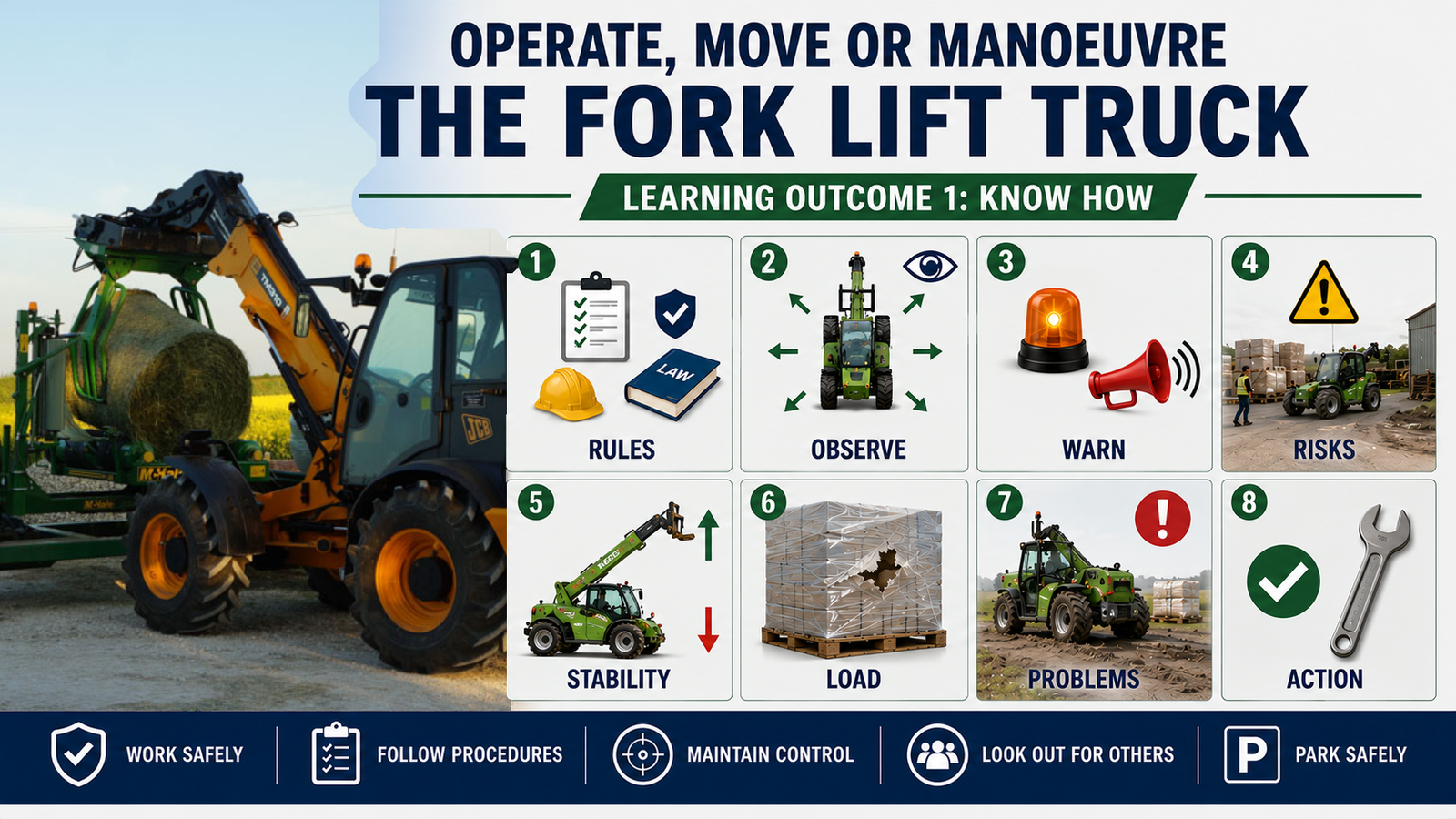
Learning Outcome 1: Know how to operate, move or manoeuvre the fork lift truck.
Assessment criteria:
- 1.1 Explain relevant organisational policies and procedures for operating, moving or manoeuvring the fork lift truck relating to health, safety and security, PPE, legal and operating requirements, different locations, different loads, and theft or damage.
- 1.2 Explain the observations required for operating, moving or manoeuvring the fork lift truck.
- 1.3 Explain how different audible and/or visual warning devices are used.
- 1.4 Describe the risks associated with driving, moving or manoeuvring the fork lift truck at different locations.
- 1.5 Explain the factors that can affect the stability of the fork lift truck.
- 1.6 Describe how to identify damage or deterioration in the condition of the load.
- 1.7 Identify problems that can occur when driving, moving or manoeuvring the fork lift truck.
- 1.8 Explain the appropriate action to take for identified problems.
Learning Outcome 2: Be able to operate, move or manoeuvre the fork lift truck.
Assessment criteria:
- 2.1 Follow relevant organisational policies and procedures for operating, moving or manoeuvring the truck relating to health, safety and security, PPE, legal and operating requirements, different locations, different loads, and theft or damage.
- 2.2 Undertake a visual risk assessment of the working area.
- 2.3 Check visual aids to ensure all-round vision.
- 2.4 Mount the equipment safely and make appropriate adjustments to controls.
- 2.5 Position forks or attachments for loading or travelling.
- 2.6 Undertake correct observations.
- 2.7 Operate, move or manoeuvre the truck smoothly while maintaining stability of truck and load.
- 2.8 Negotiate inclines and declines to maintain stability of truck and load.
- 2.9 Locate a suitable turning space and align pivot and reference points sufficiently.
- 2.10 Turn the truck in a manner that maintains stability of truck and load.
- 2.11 Stop the truck in a manner that maintains stability of truck and load.
- 2.12 Position the truck and attachments in an authorised position, location or parking bay when not in use.
- 2.13 Dismount the fork lift truck safely.
- 2.14 Record all work according to organisational requirements.
60-Second Recap
- Name two factors that affect truck stability.
- What observations must be completed before turning?
- How do you protect stability on inclines or declines?
- What must be recorded when the task is complete?
Yard Scenario
Your route includes a slope, a blind corner and a parked trailer. What is your safe sequence of actions?
Reveal model answer
Slow and observe early, use warning devices where required, keep load stable and low for travel, control speed on slope, and complete the turn only when reference points and clearances are confirmed.
How confident are you on this section?
Pick one to save your progress on this device.
Revision Prompts for Practice Quick fire
- How do you adjust your checks and observations between open yards and tight spaces?
- What are your key reference points when turning with a load?
- How do you keep truck and load stable on inclines and declines?
- What documentation is required after manoeuvring tasks on your site?
Go to the interactive revision page
Pair Challenge
With a partner, explain one risk at a loading bay and one action that reduces that risk. Swap and score each other out of 3.
How confident are you on this section?
Pick one to save your progress on this device.