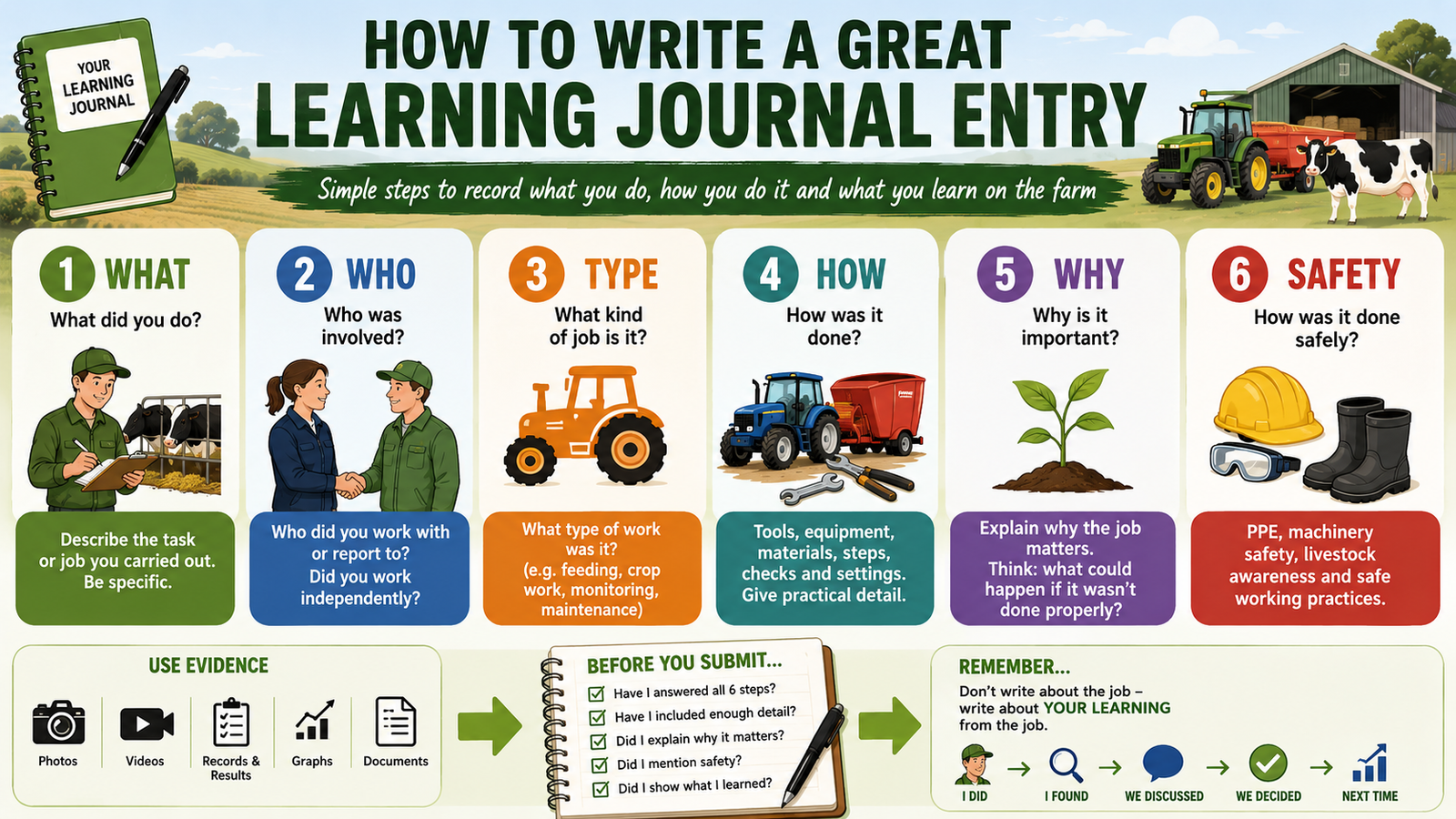
How to Write a Great Learning Journal Entry
Your Learning Journal is a record of what you do and what you are learning at work. You do not need to write an essay.
A good entry explains:
- What you did
- How you did it
- Why it matters
- What you learned
Use the same 6 Steps for both Level 2 and Level 3. The difference is that Level 3 entries should show more monitoring, discussion, reflection and understanding.
Remember: short, clear and useful is better than a long entry full of waffle.
The 6 Steps to Great Journal Entries
6 Steps to Great Journal Entries
Use Photos, Records & Other Evidence
Your journal does not have to be just words.
- Photos
- Videos
- Monitoring results
- Records and checks
- Graphs
- Relevant documents
If you can show something with a photo, show it. If you measured it, include the result. Use your writing to explain what the evidence shows.
Before You Press Submit
Ask yourself:
- WHAT? Have I said exactly what I did?
- WHO? Have I said who I worked with or reported to?
- TYPE? Have I explained what sort of farm job it was?
- HOW? Have I included enough practical detail?
- WHY? Have I explained why the job matters?
- SAFETY? Have I explained how I worked safely?
Level 3 extra check:
- What did I find?
- Did I discuss it?
- What happened next?
The Golden Rule
Don't just write about the job. Write about YOUR learning from the job.
Instead of:
“We spread muck.”
Try:
“I spread muck onto stubble land before it was ploughed for winter wheat. We aimed for an even application across the field. I learned that weather conditions are important because spreading in unsuitable conditions can increase the risk of run-off. I also checked that the spreader was maintained and operating correctly.”
You don't need perfect spelling, complicated words or pages and pages of writing.
Write it in your own words.
What I did → how I did it → why I did it → what I learned.
Level 2 GFW: Daily Tasks & Duties
For Level 2 General Farm Worker apprentices, most journal entries will be about the daily jobs and duties you carry out on the farm.
These might include feeding livestock, checking animals, moving stock, cleaning and bedding, water checks, fencing, muck spreading, machinery operation, maintenance, grassland and crop work, harvesting, animal health and biosecurity.
Don't try to make the job sound complicated. Show that you can carry it out and understand what you are doing.
Think:
- WHAT: What job did I do?
- WHO: Who did I work with?
- TYPE: What sort of farm job was it?
- HOW: What tools, equipment and steps did I use?
- WHY: Why does the job matter?
- SAFETY: How did I work safely?
Level 2: Keep It Simple
You don't have to write loads. Short answers to the six questions can make a useful entry.
- What: Fed store cattle with silage.
- Who: Worked with my supervisor.
- Type: Daily livestock husbandry.
- How: Used the feeder wagon and checked water.
- Why: To support growth and animal health.
- Safety: Used PPE and worked safely around machinery and cattle.
Six useful answers are better than one sentence saying “I did it”.
Need Help With a Specific Farm Duty?
For help with Learning Journal entries for each duty, use the Farm Duties Hub.
The Farm Duties Hub provides guidance for the Core Livestock and Crop Duties that apprentices carry out on the farm.
Find your duty, then use the guidance to help build your journal entry.
Open the Farm Duties HubUse the duty guidance alongside the 6 Steps to help describe what you did, how you did it, why it matters and what you learned.
Level 3: Tasks, Monitoring & Learning
Level 3 apprentices can still use the same six steps, but should increasingly show the thinking behind the job.
Think:
- DO — carry out the practical work
- OBSERVE — monitor what is happening
- THINK — consider what the information means
- DISCUSS — talk through findings with a supervisor or manager
- DECIDE — contribute to what happens next
This is particularly important for crop and livestock monitoring projects.
Level 3: Monitoring Entries
When you are monitoring livestock or crops, don't stop at saying what you measured or observed.
Try to answer:
- What did I monitor?
- What did I find?
- What does it mean?
- Who did I discuss it with?
- What was decided?
- What happens next?
Useful formula: Monitor → Find → Discuss → Decide → Act → Review
Level 3: Discussion & Feedback
Some of your best journal entries may happen after the practical work. You do not always have to be operating machinery, checking livestock or walking a crop.
A useful discussion with a supervisor, farm manager, agronomist, vet, nutritionist or other experienced person can be a learning journal entry.
Record:
- What you discussed
- The information or findings you brought to the discussion
- What you learned from the discussion
- Any advice or feedback you received
- Any information or feedback you gave
- What was agreed to happen next
Remember: you do not have to make the final decision. Showing that you noticed, recorded, communicated and contributed is valuable evidence.
Level 3: Projects
Level 3 entries should link practical work, monitoring and discussions to your projects wherever possible.
Farm For Food
- Production and quality
- Yield and livestock performance
- Product quality and markets
- Efficiency and the effect of decisions on production
Farm Guard
- Biosecurity and animal health
- Crop protection and disease prevention
- Identifying risks and improving practice
Farm Safe
- Hazards and risk
- Machinery and livestock handling
- Chemicals, PPE and safe systems of work
- Reporting and improving safety
Farm For Future
- Soil and water
- Nutrient and input use
- Biodiversity and environmental impact
- Energy, waste and sustainable farming practice
Crop & Livestock Monitoring
Monitoring projects are a chance to show that you can use information to understand what is happening on the farm.
For livestock, this could include weights, growth, health, condition, feed intake or performance.
For crops, this could include crop growth, establishment, weeds, pests, disease, nutrient status or yield-related information.
Don't just record the number or observation. Explain what the result shows and why it matters.
Then record any discussion with your supervisor or manager and what you agreed to monitor, change or review next.
Level 3: What Happened Afterwards?
One of the best ways to make a Level 3 entry stronger is to come back to it later.
For example, after discussing market returns, record what the results showed, what you changed or considered changing, and what you will look at in the next batch.
This creates a useful record:
- Monitor what is happening
- Discuss the results
- Decide what to do
- Act on the decision
- Review the outcome
This shows reflection and improvement rather than simply recording that a conversation happened.
Try an interactive session to help you create your first learning journal entries Try the interactive session