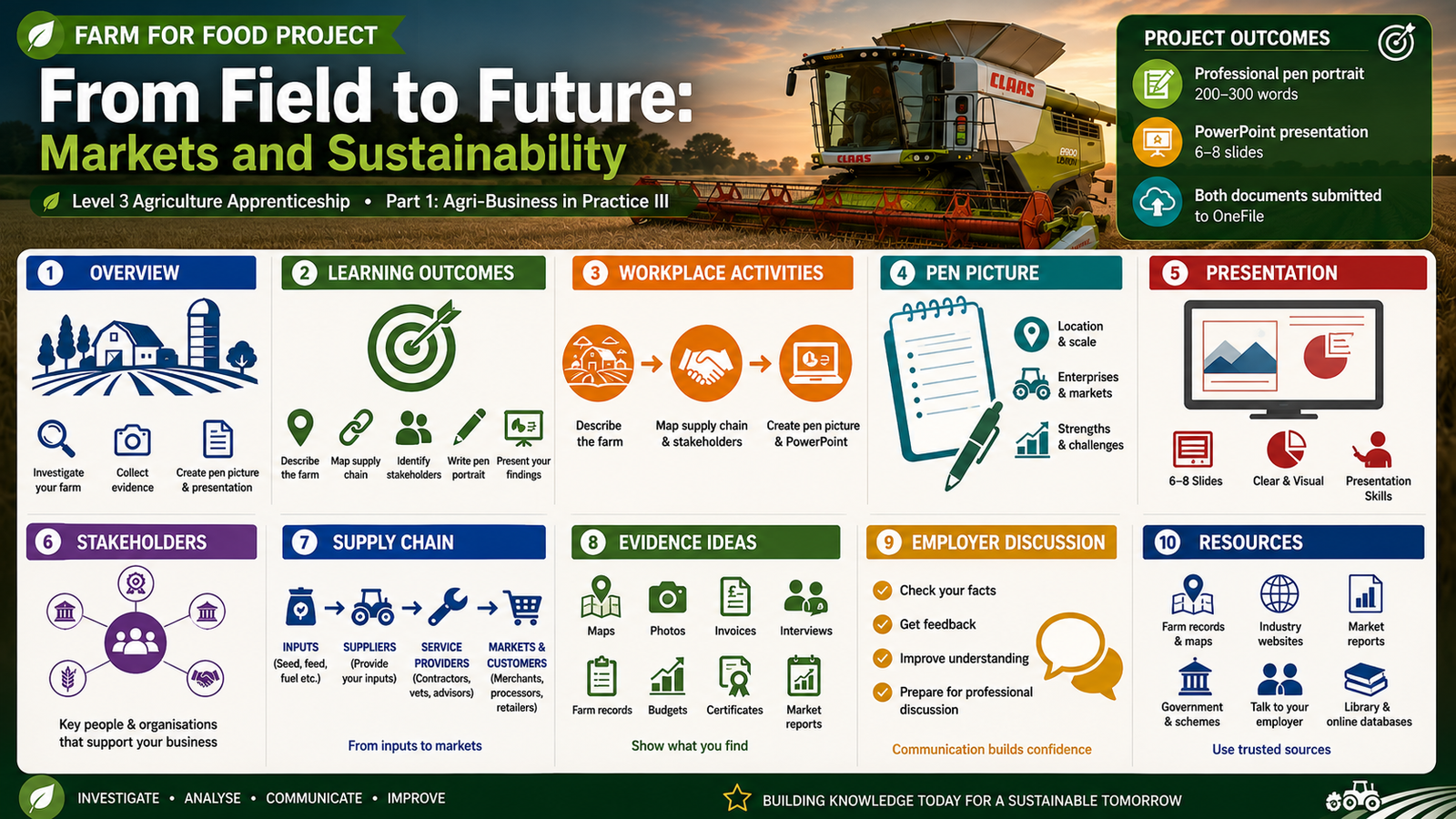
Project Overview
Agricultural businesses are complex, living systems involving enterprises, supply chains, suppliers, service providers and customers. In this first part of the project, you will investigate your farm or workplace and build a clear picture of how it operates.
You will collect evidence (maps, photographs, invoices, interviews) and complete each section, building:
- A professional pen portrait (200–300 words) summarising your farm's scale, enterprises, market position, strengths and challenges
- A PowerPoint presentation (6–8 slides) presenting your pen picture and supply chain — excellent practice for interview and presentation skills
- Both documents submitted to OneFile for assessment
Learning Outcomes
Part 1 Aims — By the end of this project you will:
- Describe the farm accurately — size, location, soils, climate, and main enterprises
- Map the supply chain for each enterprise, including inputs, suppliers, service providers, markets and customers
- Identify key stakeholders in the business (finance providers, assurance bodies, regulators, industry bodies)
- Summarise the business in a clear, professional pen portrait suitable for an external visitor or assessor
- Communicate your findings clearly in both written form and a short PowerPoint presentation
Workplace Activities
Task A: Describe the Farm
Collect basic details: farm name, address, What3Words location. Record total area, breakdown by land use (cereals, grass, livestock numbers, etc.). Document climate notes, aspect and soil types using farm records, maps or soil surveys.
Task B: Understand Supply Chain & Stakeholders
For each main enterprise, map inputs → suppliers → service providers → stakeholders. Identify who supplies you (seed, feed, fuel), who services you (contractors, vets, agronomists), who you sell to (merchants, processors, markets), and who regulates you (assurance schemes, government bodies, industry organisations).
Task C: Create Pen Picture & PowerPoint
Write a professional 200–300 word summary of your farm's business focus, scale, market position, strengths and challenges. Produce a 6–8 slide PowerPoint presentation presenting your pen picture and supply chain — ideal for practicing interview and presentation skills.
Pen Picture Guidance
What is a pen picture? A short professional summary that explains how your farm business operates and where it is positioned.
Use this 3-paragraph structure:
- Paragraph 1: Location and scale of the business
- Paragraph 2: Main enterprises, products and markets
- Paragraph 3: Strengths and challenges
Sentence starters
- XYZ Farm is a _____ hectare _____ farm located in _____.
- The business produces _____.
- Strengths include _____.
- Current challenges include _____.
Presentation Guidance
Use your pen picture and evidence to build a clear 6–8 slide presentation.
Suggested slide structure
- Slide 1: Farm introduction
- Slide 2: Location and soils
- Slide 3: Main enterprises
- Slide 4: Key stakeholders
- Slide 5: Supply chain
- Slide 6: Strengths and challenges
- Slide 7: Future opportunities
- Slide 8: Summary
Tip: Keep slides visual and concise, then use your spoken explanation to add detail from your workplace evidence.
Stakeholders Review
In Case You Missed It
What is a stakeholder? An individual or group with an interest in the business who may affect, or be affected by, farm activities.
Use this to support your project write-up:
- Internal stakeholders: Owners, managers and employees
- External stakeholders: Customers, suppliers, banks, government, communities and trade organisations
Quick stakeholder map prompt: Customers, Suppliers, Your Farm, Community, Banks, Government, Advisors.
Supply Chain Review
In Case You Missed It
Why supply chain matters: it shows how inputs become outputs and who adds value from farm to consumer.
Include these links in your project analysis:
- Inputs
- Suppliers
- Customers
- Service providers
- Finance providers
- Assurance organisations and trade bodies
Example chains
- Wheat: Seed to Farm to Merchant to Mill to Bakery to Supermarket to Consumer
- Beef: Feed to Farm to Abattoir to Processor to Retailer to Consumer
Evidence Ideas
Collect a variety of evidence to support your work:
- Farm maps and aerial photographs
- Invoices, delivery tickets and supplier communications
- Contracts and email exchanges with customers
- Stakeholder and supply chain diagrams (hand-drawn or digital)
- Written pen portrait (professional summary)
- PowerPoint presentation slides (6–8 slides)
- Learning journal entries documenting your progress
- Supervisor or mentor discussion notes
Employer Discussion
Use these topics to guide conversations with your supervisor or mentor:
- How do suppliers, service providers and input costs support the farm's main enterprises?
- Who are the key stakeholders in your farm business? Why are they important to the operation?
- How does your farm fit into the wider agricultural supply chain — from field to consumer?
- What are the farm's main strengths and current challenges?
- How does the farm's market position and business focus affect management decisions?
- What factors affect UK agriculture — both internal (farm control) and external (market/environmental)?
Useful Resources
Benchmarking & Market Data
- AHDB – Cost of Production & Input Prices — Regularly updated data on input costs and margins
- AHDB – Agri Market Outlook — Annual market snapshots and forecasts
- Farm Business Survey – Crop Production 2023/2024 — Detailed costs and outputs
Financial & Sustainability Tools
- GOV.UK – Agricultural Price Indices — Historical price trends
- FAS Scotland – Arable Gross Margins — Margin calculation guidance
- Bayer Crop Science – Unit Cost of Production — Practical CoP calculation
Background & Context
- Wikipedia – Integrated Farming — Sustainability principles overview
- Wikipedia – Agriculture in the UK — Sector context and statistics